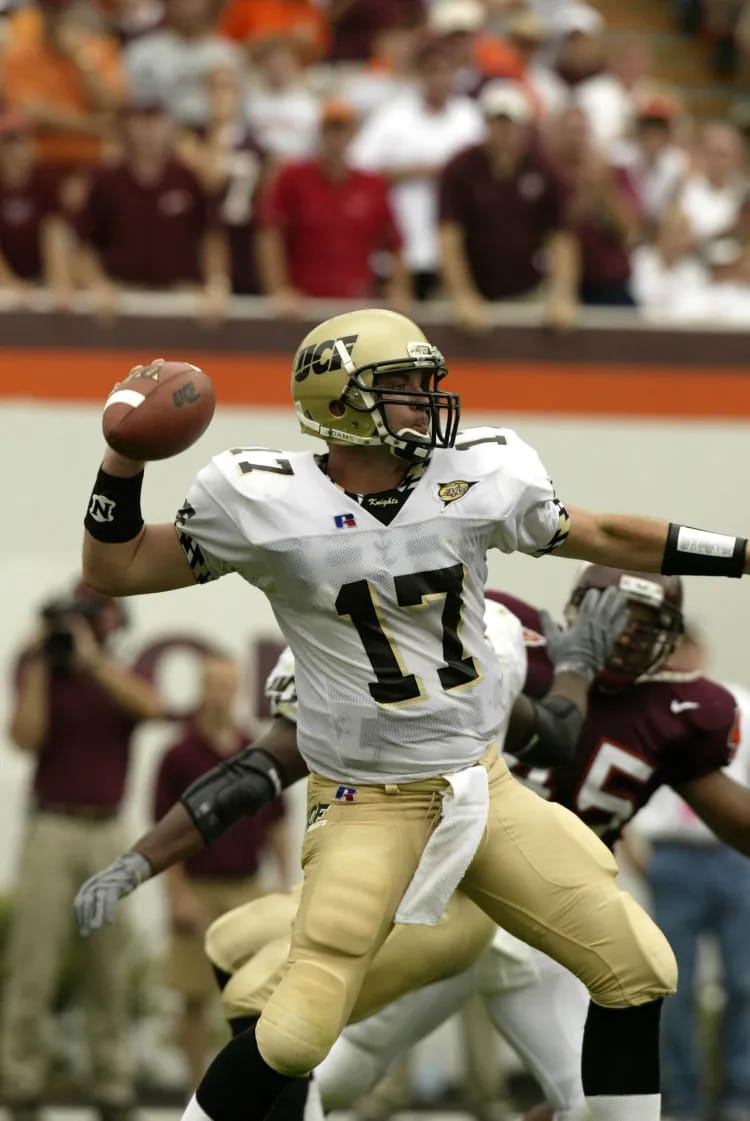
Some time ago, on an episode of Locked On UCF, a discussion of who should be on a UCF super team of top players from 2000 and beyond was held. Three teams were presented, and I had very strong opinions about the list, noting that several legacy players were missing. In my opinion, this was due to a combination of recency bias and age. I decided a fourth team is needed. This particular team had only players not listed on the other three, and all predate Scott Frost. It is also worth noting that I have seen these players in play during their time at UCF
Quarterback – Ryan Schneider (2000-2003)

Ryan Schneider was a gunslinger quarterback who brought UCF from the ranks of the Division I-A independents to the Mid-American Conference. Schneider broke onto the scene in 2000 after starting quarterback Vic Penn was injured. Schneider’s first start would be his first of many 300-yard games, and he never looked back. In UCF’s signature win over Alabama, the redshirt freshman would throw for 283 yards and three touchdowns.
Schneider was in a position to break multiple UCF school records in the 2003 season as a senior. Unfortunately, a disciplinary issue ended his season early, and he failed to pass Daunte Culpepper in career passing attempts, completions, passing yards, and passing touchdowns. He still ranks second in all of these school records.
Despite the shortened senior season, Schneider either held or still holds these school records.
*Pass completions in a game
Passing yards in a game(Dillon Gabriel, 2020)
Passing yards in a season(McKenzie Milton, 2017)
Passing yards by a freshman quarterback(Gabriel, 2019)
*300-yard passing games in a season(tied)
*300-yard passing games in a career(tied)
400-yard passing games in a season(Gabriel, 2020)
400-yard passing games in a career(Gabriel)
Passing touchdowns in a season(Milton, 2017)
*Consecutive games with a touchdown pass
Total offense in a game(Milton, 2017)
(*) Still owned by Schneider as of May 2026
Running Back – Latavius Murray/Brynn Harvey (2008-2012)


Keeping this to college only, this UCF Super Team spot was a duel between Latavius Murray and Brynn Harvey. Both played from 2008 to 2012, both lost a season to injury, each had a 200-yard rushing game, and both had 1,100-yard rushing seasons. These two players’ careers mirrored each other to the point where you have to have them together.
A Crowded Stable
Murray and Harvey were victims of circumstance during their time at UCF. First, they were part of the trio of freshman running backs who had to follow Kevin Smith. They, and Ronnie Weaver, ended up stealing carries from each other. In that 2008 season, Harvey had the best showing of the three and was expected to become the feature back.
In 2009, Murray missed the season due to injury. He nearly transferred to Syracuse to be closer to home and was granted his release by then-head coach George O’Leary. He ultimately decided to stay at UCF.
Meanwhile, Harvey took advantage and excelled in 2009 with 261 carries, 1,109 yards, and 14 touchdowns.
Flipping the Script
2010 flipped the script as Harvey was out that year due to injury. As a result, Murray ended up splitting carries with Weaver. Murray only started four games and ran for 637 yards compared to 890 yards for Weaver. One has to wonder if Murray’s lack of featured time had anything to do with his release and near-transfer to Syracuse the year prior.
Murray became the feature back in the second half of the season and capped it off with the winning touchdown against Georgia in the 2010 AutoZone Liberty Bowl — UCF’s first bowl win.
2011 was 2008 all over again. Harvey and Murray split starts with Weaver who recorded five, two, and five respectively. However, the big two had the best results. The 2011 season was a mess at quarterback, which didn’t help the running game.
Harvey’s usage was inconsistent early on, while Weaver cannibalized carries. Murray had low usage through most of the year, with single-digit carries in eight games. Murray capped the underachieving 2011 season with a 233-yard game and solidified himself as the primary back going forward.
In 2012, Latavius Murray was in the driver’s seat. Ronnie Weaver had graduated, but Storm Johnson transferred in from Miami and became RB2, pushing Harvey into RB3 obscurity, similar to Murray in 2008. Murray had a career-best 198 carries, 1,106 yards, and 15 touchdowns.
Two Amazing Careers that Could Have Been More
This is a good “what-if” scenario. What if Murray and Harvey didn’t play together over the same five-year span? What if O’Leary allowed one to be the feature back sooner?What if each avoided losing a season due to injury? Harvey never had an NFL career, but Murray had a very successful ten-year career at the highest level.
By the time their playing at UCF ended, both Murray and Harvey were in the top 10 for rushing carries in a season and career, rushing touchdowns in a season and career, and 100-yard and 200-yard games in a season and career. Murray owns the school record for the highest average yards per carry in a single game (minimum of 10 carries). Both are worthy of a place on the UCF Super Team.
Wide Receiver 1 – Mike Sims-Walker (2003-2006)

Mike Sims-Walker, then known as Mike Walker, was an easy pick as WR1 for the UCF Super Team.
Sims-Walker got to work early as a true freshman in 2003. In 2004, due to injuries in the secondary, Sims-Walker spent most of the season on the defensive side of the ball and led the team in interceptions. Despite that, Sims-Walker did play sparingly on offense in the second half of the season, logging at least one catch in each of the final five games and finishing fourth on the team with 191 receiving yards.
In 2005, Sims-Walker’s career began to blossom. In the season opener, he recorded his first 100-yard game and played a pivotal role in the Knights winning their first divisional title. He missed the Conference USA Championship Game and Sheraton Hawaii Bowl due to a serious knee injury. That injury prevented him from potentially having a 1,000-yard season, finishing with 855 yards. He made up for that in his senior season in 2006.
Despite a two-quarterback system in which neither was impressive, Sims-Walker carried the passing game. He had a team-record 90 receptions for 1,178 yards and seven touchdowns, averaging just under 100 yards a game. That accounted for 39.6% of the team’s receptions, 41.2% of yards, and 50% of receiving touchdowns.
Sims-Walker caught multiple passes in each of his final 25 games, spanning from late 2004 all the way through 2006. In fact, over the final 24 games, he never had fewer than three catches or 32 yards.
When his career ended, Sims-Walker set a record for receptions in a season, a record that still stands. He also finished fourth in receiving yards in a season, third in career receiving yards, fourth in receptions in a game, and fourth in career receptions. Sims-Walker is one of the few Knights to ever be on a 100-yard receiving game tandem in multiple seasons. In many cases, Sims-Walker was the stat leader among players who played in 2000 and beyond.
Wide Receiver 2 – Jimmy Fryzel (1999-2002)

A crowded field
The second UCF Super Team wide receiver was a personal debate between Jimmy Fryzel, Doug Gabriel, Tyson Hinshaw, J.J. Worton, and Brandon Marshall, but in the end, there could be only one. As honorable mentions, Gabriel, Hinshaw, Worton, and Marshall were all missing something.
In Gabriel’s case, he played only two seasons at UCF despite setting a school record for receiving yards in a season, a mark that stood for 17 years and was part of the highest single-season yardage WR tandem in school history. He also had the highest career yards per reception record until it was broken a dozen years later. Gabriel was also the single-game and season school record holder for all-purpose yards, which were both broken by Kevin Smith in 2007. Hinshaw squeaked into the conversation despite having spent most of his career in the 1990s. He also had two strong seasons, including a then-school-record 89 catches in 2000 that Sims-Walker eventually eclipsed. Hinshaw and Gabriel each had a 200-yard receiving game. If Gabriel was at UCF longer or there was a WR3 spot, he’d be my guy, but you can still make a very compelling argument in his favor.
Worton was a consistent contributor, with over 500 receiving yards over four years, but never had a 1,000-yard season like everyone else. He led the team in receiving yards in his freshman season and had a catch so impressive that ESPN studied it on Sports Science, but he was more of a dependable safety valve than an ace. Marshall was more of a one-hit wonder on the stat sheet. His dominant senior season in 2005 put him on the map and set him on the path to an outstanding NFL career. If professional careers were being used, he’d be WR2. Like Sims-Walker, Marshall lost most of the 2004 season after being moved to defense due to injuries.
A Model of Consistency
Jimmy Fryzel was a model of consistency, catching no less than 35 passes for 600 yards in his sophomore through senior seasons. While not as explosive as Gabriel, Fryzel consistently caught multiple passes a game. At one point, he caught multiple passes in 22-straight games. From game number two of his sophomore season in 2000 through the end of his UCF career, Fryzel had at least one catch and at least 28 yards per game.
By the time Fryzel’s career ended, he was fourth in career receiving yards, tied for second in consecutive 100-yard receiving games, and third in yards per reception.
In 2002, he, along with Doug Gabriel, set the school record for the highest single-season yardage by a WR tandem in school history, as Gabriel had 1,237 yards and Fryzel 1,126. It is the only season in UCF history when the Knights had two 1000-yard receivers. During that season, the two combined for 356 yards against Syracuse. That record still stands.
Tight End – Darcy Johnson (2002-2005)
This was arguably the toughest decision to make between Darcy Johnson and Michael Gaines. On one side, you have Johnson, who was a better receiving tight end, versus Gaines, who was a better blocker and had a much better NFL career. This isn’t about their NFL career, though. Johnson had 35 starts in 48 games and never missed a game. Gaines played in 25 games, and he was never the primary tight end.
Johnson’s best season was UCF’s first bowl game season in 2005, when he ranked third in receiving with 36 catches for 435 yards and a pair of touchdowns. Johnson is one of the few players here who played for both Mike Kruczek and George O’Leary.
Offensive Line – 2013

The 2013 Offensive Line was stacked. The starting group of Torrian Wilson at left tackle, Jordan McCray at left guard, Joey Grant at center, Justin McCray at right guard, and Chris Martin at right tackle helped create one of UCF’s best seasons ever. The team went 12-1 and went to(and won) their only BCS bowl as champions of the American Athletic Conference. The McCray twins were both named first team All-AAC, while they, Wilson, and Martin all received all-conference honors from Phil Steele. They are clearly worthy of a UCF super team.
Defense – 2014

The 2014 Defense was a vastly underrated unit that helped propel UCF to a second consecutive American Athletic Conference championship. Unlike 2013, which was stacked offensively, the 2014 offense was nowhere near as good and definitely not championship caliber. It took the defense stepping up.
The Knights had two players, Terrance Plummer and Clayton Geathers, finish just shy of 100 tackles each. They, along with the next two top tacklers, Brandon Alexander and Jordan Ozerities, each recorded at least one interception. The defense held opponents to 14 or fewer points in seven games, including one shutout, which is the last time UCF has shut out an FBS opponent. In three of those games, the offense failed to reach 21 points. The 2010 defense also makes a strong case for inclusion in the UCF Super Team.